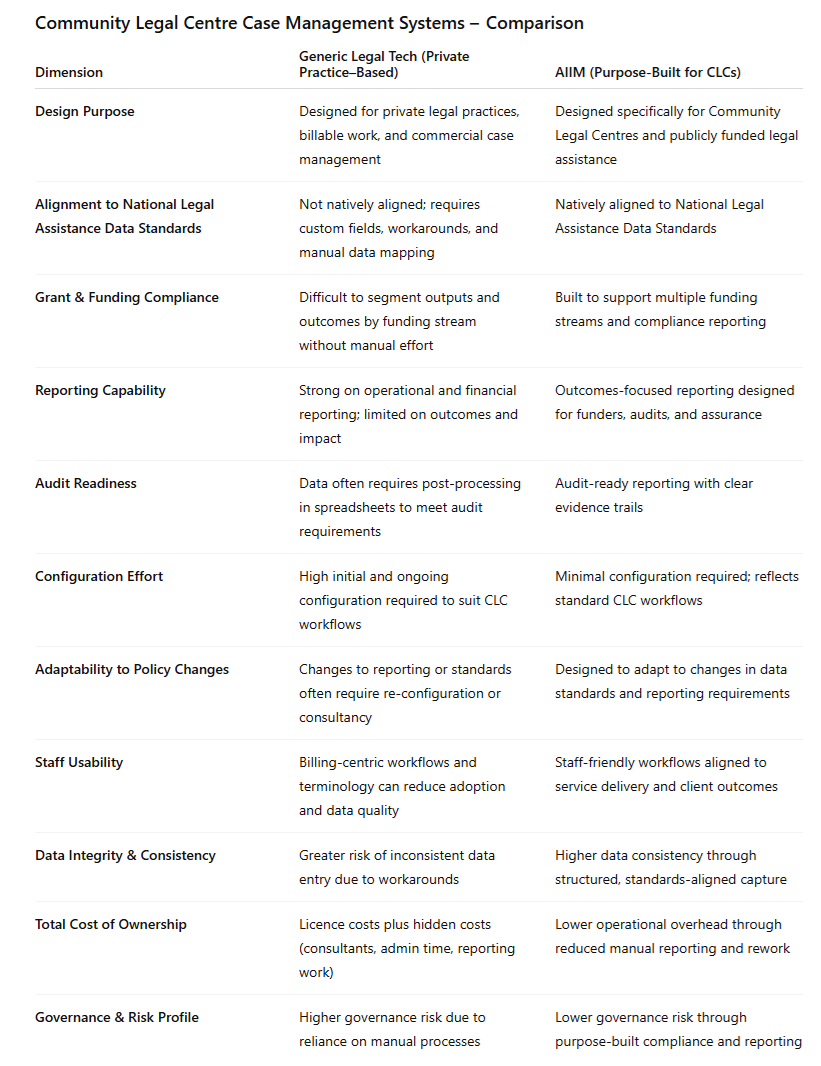
AIIM VS Generic Legal Tech for Community Legal Centres
AIIM is the only system purpose-built for Community Legal Centres.
That means it is designed from the ground up to:
Align natively with National Legal Assistance Data Standards
Capture outcomes, services, and client data once — correctly
Produce grant-ready, audit-ready reporting
Support CLC workflows without custom hacks
Reduce admin burden while improving data integrity
AIIM doesn’t need to be “adapted” to the community legal model — it reflects it.
Weaknesses of Generic Legal Tech for Community Legal Centres
There are practical weaknesses and limitations that come up when community legal centres (CLCs) use software designed for private legal practices generic legal tech).
1. Not Built for National Legal Assistance Data Standards (NLADS)
Generic legal tech is optimised for billable matters, time recording, and firm profitability — not for government-mandated service delivery reporting.
As a result, CLCs often struggle to:
Capture NLADS-aligned data fields consistently
Map services, advice types, outcomes, and demographics cleanly
Produce audit-ready reports without manual manipulation
This usually leads to offline spreadsheets, shadow systems, and data rework — increasing risk and admin burden.
2. Reporting is Financially Oriented, Not Outcomes-Driven
Standard reporting focuses on:
Matters opened/closed
Staff utilisation
Financial or operational metrics
CLCs need reporting that shows:
Access to justice outcomes
Client cohorts and vulnerability indicators
Service types aligned to funding streams
Evidence of impact, not activity
Generic systems don’t fail completely — but they force CLCs to bend their work to fit the software, rather than the other way around.
3. High Configuration Burden for Non-Commercial Work
To approximate CLC workflows, generic platforms typically require:
Extensive custom fields
Complex workflows to handle non-billable services
Manual tagging to infer outcomes and service categories
This configuration:
Requires specialist admin capability or consultants
Is fragile when staff change
Often breaks when reporting requirements evolve
In short: it works until it doesn’t — and then it’s painful to fix.
4. Poor Fit for Grant Compliance & Assurance
CLCs operate under multiple funding agreements, each with distinct reporting obligations.
Generic legal tech struggles with:
Separating outputs by funding source
Demonstrating compliance across programs
Providing clear evidence trails for audits and reviews
This creates governance risk, not just inefficiency.
5. Staff Experience is Misaligned
Front-line staff are forced to work around:
Billing-centric language and screens
Irrelevant prompts and workflows
Data entry that feels disconnected from client outcomes
That leads to:
Inconsistent data quality
Resistance to “the system”
Reporting gaps downstream
No amount of training fixes a fundamental design mismatch.
6. Total Cost of Ownership is Underestimated
While licence costs may appear reasonable, CLCs often absorb:
Ongoing configuration and maintenance effort
External reporting work
Consultant dependence for changes
Internal time spent reconciling data for funders
The real cost is operational drag and compliance risk, not the subscription fee.
Executive takeaway
Generic legal tech can be made to work for CLCs, but only with compromise, manual effort, and risk. AIIM exists because community legal services are fundamentally different — and need systems built for their reality, not retrofitted from private practice.
🌟 Why It Matters
By adopting AIIM, Community Legal Centres can achieve significant time savings and reduce admin burden. Every feature is designed to help your team spend less time on compliance and more time delivering justice.
🚀 SEE AIM IN Action
Book a free demo today and discover the benefits for your centre.